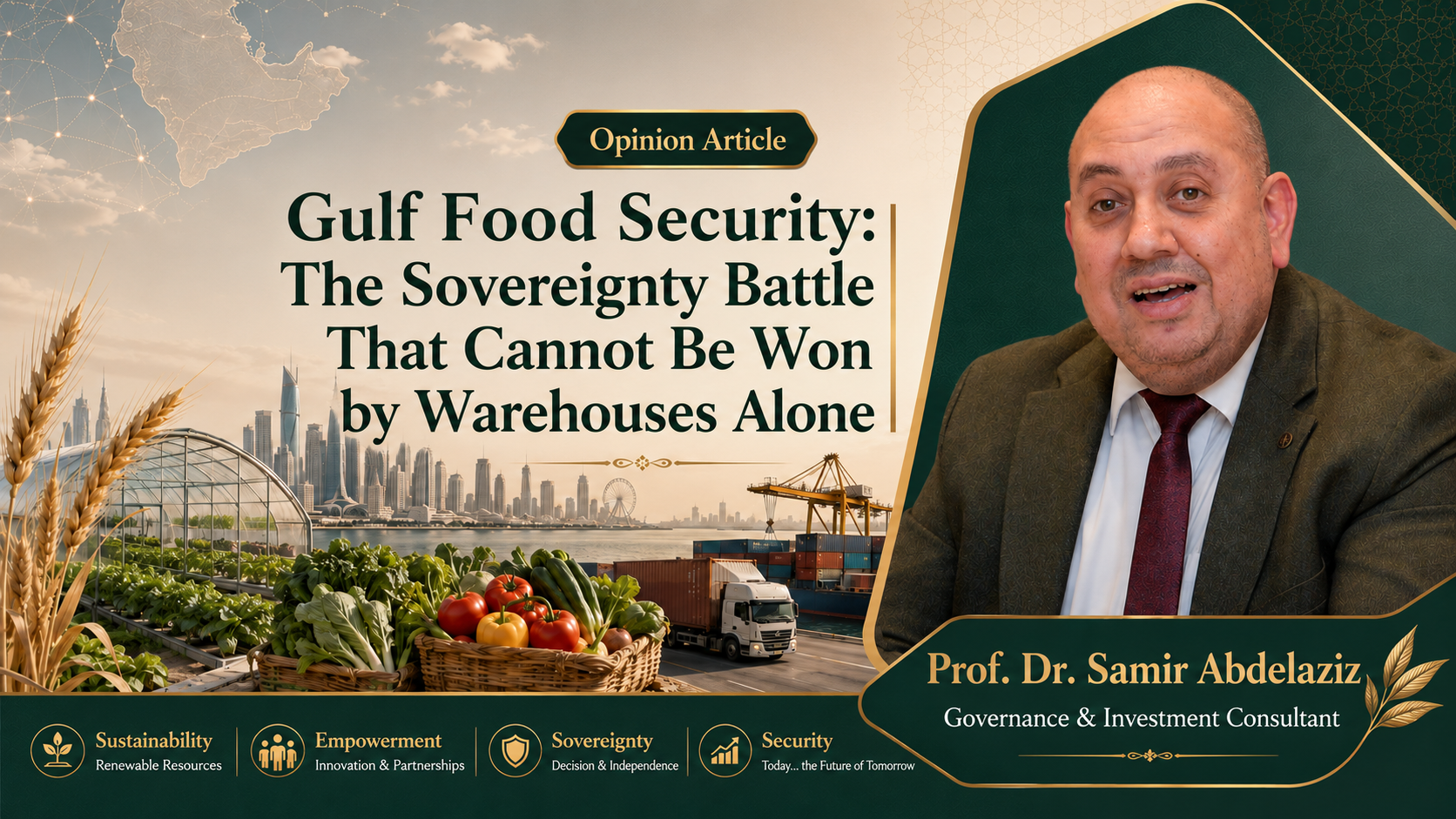
By: Dr. Samir Abdel Aziz
Governance and Investment Consultant
When food security in the Gulf states is mentioned, the conversation often turns to establishing farms, increasing strategic reserves, and supporting local production. These are certainly necessary tools, but they represent only parts of a broader and more complex system.
Food security is not merely the ability to produce food, nor does it mean achieving full self-sufficiency in every crop and commodity. Rather, it means that the state possesses the sustainable capacity to provide safe, sufficient and appropriate food for its citizens and residents, in normal times and in crises, at affordable prices, and from sources and routes that are not easily disrupted.
Hence, the real question that should occupy Gulf states is not: How much do we produce locally? but: To what extent can our food system withstand disruptions if some trade routes are interrupted, global prices rise, or supplies from a supplying country decline?
FAO indicates that Gulf states rely on imports for between 70% and 90% of their basic food needs. This reliance is imposed by limited arable land, scarce water and harsh climatic conditions, but it makes the region more sensitive to disruptions in trade, transport, energy and international supply chains.
The problem is not imports… but uncalculated dependence
Importing food in itself is not a weakness. Advanced economies import part of their needs, re-export part, and build transcontinental trade networks.
The problem arises when imports depend on a limited number of countries, a single maritime corridor, suppliers with no ready alternatives, or when contracts are short-term and not linked to early-warning systems, flexible reserves and clear crisis operation plans.
For this reason, managing food security requires the logic of investment portfolio management; essential needs should not be placed in a single geographic basket, nor rely on a single transport mode, nor treat price as the sole selection criterion.
The cheapest supplier may be the riskiest if their country is exposed to drought, political unrest or sudden export restrictions. Conversely, a higher-priced supplier may be more valuable if they offer long-term contracts, alternative transport routes and guaranteed supply capacity during crises.
Food security, in this sense, is a precise balancing act between cost, sovereignty, sustainability and resilience.
Local production matters… but not at any cost
Gulf states need to bolster local production, particularly for fresh and perishable goods and certain strategic animal, fishery and food products. But turning self-sufficiency into an absolute goal can lead to the depletion of water, energy and financial resources producing crops ill-suited to the region’s environmental and economic realities.
The GCC faces structural challenges related to scarcity of surface water, unsustainable groundwater depletion, and high costs of water and energy provision, making the water–food–energy nexus fundamental to any prudent agricultural policy.
Therefore, the objective should not be to produce everything, but to produce what we have a comparative advantage in or what is of strategic necessity.
This means directing investment to protected and smart agriculture, vertical farming, aquaculture, reuse of treated water, developing seeds tolerant to heat and salinity, and leveraging renewable energy for cooling, desalination and operations.
It also means halting projects that look attractive in presentations but cannot remain commercially viable once government support or concessional financing ends.
A project that produces food at a perpetual loss does not constitute real food security; it can become a long-term financial burden, regardless of its PR image.
Food security begins before the farm and continues after the product arrives
The food system does not begin with sowing seeds nor end at harvest. It is an interconnected chain that includes agricultural inputs, feed, seeds, fertilizers, energy, storage, processing, cold-chain transport, ports, laboratories, distribution, retail markets, data, finance and insurance.
A country may have solid local production yet remain exposed to risks if it relies entirely on imported feed, packaging materials or spare parts for irrigation and cooling systems.
Food may be available at ports but fail to reach markets efficiently due to weak storage, transport, or poor coordination among stakeholders.
Therefore, food security is not the remit of a single ministry or company. It is a national, multi-stakeholder system that requires clear governance to define responsibilities, prevent jurisdictional conflicts, link reserves to production and imports, and provide real-time data to support decision-making.
Notably, GCC states are working on a joint Gulf strategy for food security, while Qatar has adopted its National Food Security Strategy 2030 under the banner of building a resilient, sustainable and equitable food system based on sustainability, partnerships, food safety and climate adaptation.
Foreign investment is not just about buying land
Gulf states possess the financial capacity and logistical expertise to build agricultural and food partnerships in countries with available land, water, labor and natural resources.
Yet many foreign investments stumble because they begin by asking about land area before addressing the legal environment, usufruct rights, political risks, infrastructure, export capacity, transport costs, investment protection and repatriation conditions.
Land alone does not create food security.
What creates it is contractual ownership or control of an integrated value chain that begins with production, passes through processing and storage, and ends with transport to Gulf markets via multiple routes.
Therefore, foreign investments require calculated geographic diversification: a Gulf state should not tie a strategic crop to a single country, and projects should be built on robust agreements and governance, oversight and operational structures, not transient personal relations.
From strategic reserves to “strategic resilience”
Food reserves are necessary, but not a complete solution. Reserves have shelf-life, financing, storage and rotation costs, and cannot, by themselves, address a prolonged crisis.
More important is building strategic resilience that combines managed reserves, selective local production, multiple import sources, integrated foreign investments, long-term supply contracts, flexible logistics, and an information and early-warning system.
This system requires clear scenarios: What happens if a major port stops operating? What are the alternatives if a supplier country imposes export restrictions? How long does it take to reroute shipments? Which commodities should be prioritized for release from reserves? Who holds decision-making authority?
Food security is no longer measured only by reserve volumes or self-sufficiency rates, but by the food system’s capacity to continue operating under shocks. The goal is not to prevent crises—crises are part of the global reality—but to design a system that can absorb, adapt and recover quickly while maintaining market stability and public confidence.
The true test of a strategy is not the elegance of the document, but institutions’ ability to implement it when a food crisis intersects with disruptions in transport, energy or finance.
Food security is also an economic opportunity
Food security should not be presented solely as a government expenditure issue. It is one of the most promising areas to create high-quality investment opportunities in agricultural technology, food processing, logistics, cold storage, aquaculture, waste management, digital trade, laboratories, traceability and food-safety systems.
Attracting capital to the sector requires bankable projects, realistic feasibility studies, stable regulations, clear purchase contracts and performance‑linked incentives rather than rewards for mere project establishment.
This is where specialized advisory work becomes essential to translate broad national orientations into investment portfolios and executable projects—designing governance models, analyzing value chains, assessing risks, selecting markets and partners, and building financial and operational scenarios.
Investment decisions in the food sector cannot be swayed by the allure of land area or advertised production capacity; they require comprehensive due diligence linking commercial viability with strategic impact and environmental sustainability.
Conclusion
Gulf food security is not a seasonal project that appears in a crisis and recedes when markets calm. It is a continuous sovereign dossier intersecting national security, social stability, foreign policy, investment, water, energy and technology.
The most food‑secure state is not necessarily the one that produces the greatest volume of food within its borders, but the state that knows what to produce, where to import from, where to invest, how much to store and how to act when circumstances change.
The time for asking whether to invest in food security has passed.
The question that deserves an answer now is:
How do we build a Gulf food system that is resilient, economically viable and institutionally governed before the next crisis forces its answers upon us?
#FoodSecurity #GCC #FoodInvestment #NationalSecurity #Governance #RiskManagement #AgriculturalInvestment #SupplyChains #Sustainability #FoodSecurity #GCC #Agribusiness #Governance #InvestmentStrategy