Introduction: The Blame Game in Strategy and Leadership
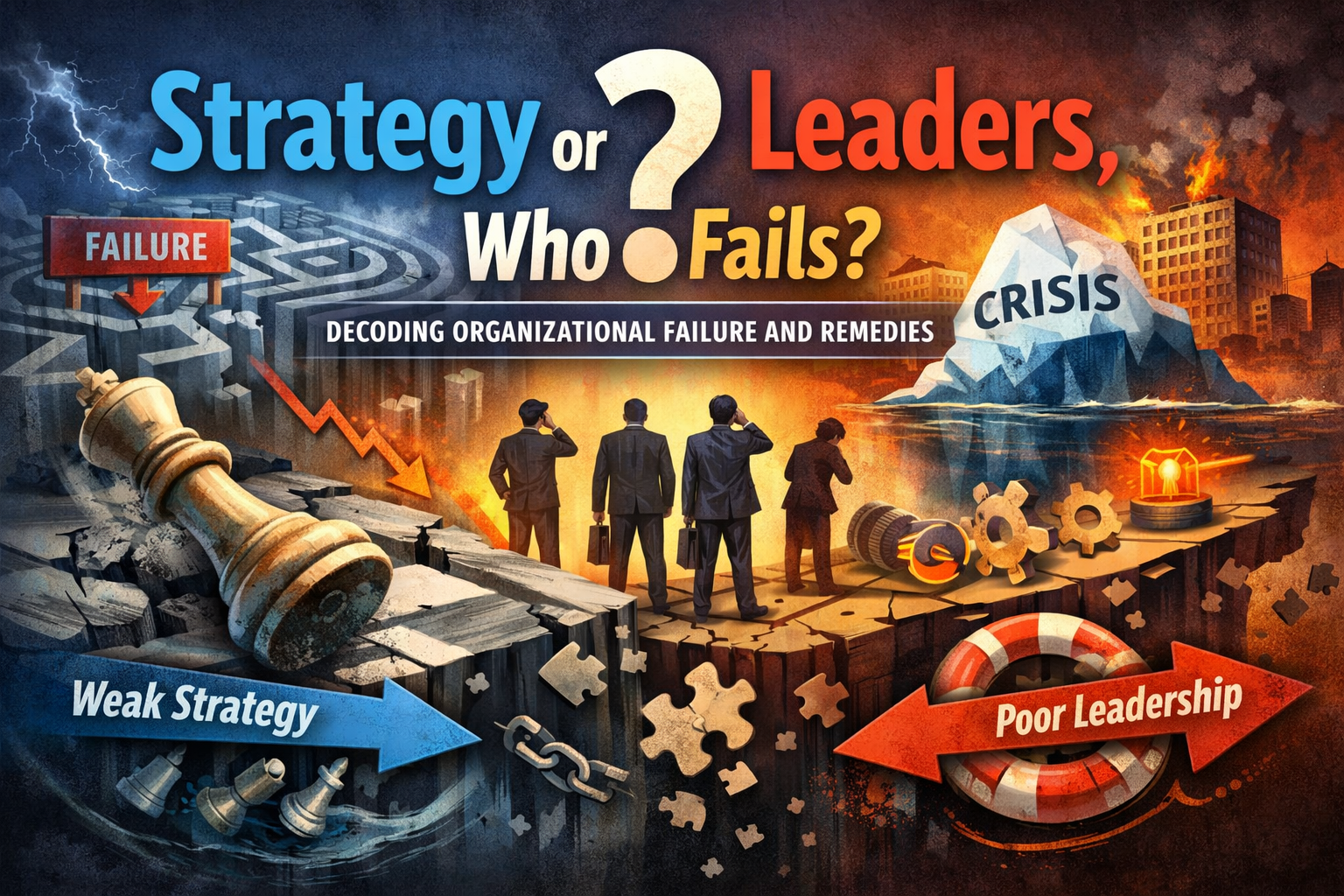
Boards, CEOs and family business principals face a recurring question: when an initiative fails, is it the strategy or the leaders? The truth is rarely binary. Failures are almost always systemic — arising from weaknesses in governance, execution capability, risk management, incentives and culture. For GCC institutions navigating Vision 2030 transformations, sovereign wealth fund allocations, or family office succession, differentiating between strategic flaws and leadership shortcomings is essential for recovery and future resilience.
Why the Question Matters
Labeling failure incorrectly wastes time and capital. If a strategy is sound but leadership lacks execution skills, replacing strategy will not solve the problem. Conversely, if charismatic leaders pursue a flawed strategy, replacing the leader without addressing strategic errors will perpetuate losses. Accurate diagnosis enables targeted interventions — governance reforms, capability-building, or strategic pivoting.
Common Patterns: Strategy Versus Leadership
Strategy failure signals: unrealistic assumptions about market size, misaligned portfolio fits, inadequate risk assessment, or poor timing for capital allocation.
Leadership failure signals: weak execution discipline, poor stakeholder communication, token accountability, and inability to rally teams behind measurable objectives.
Hybrid failures: often the most dangerous. A strategy that requires high execution rigor but is paired with weak leadership and governance will fail quickly and painfully.
Governance Diagnostics: How Boards Should Assess Failure
Boards must move beyond hindsight and ask structured questions. A governance diagnostic helps determine whether to recalibrate strategy, change leadership, or strengthen oversight.
Was the strategy stress-tested? Did management use scenario planning and sensitivity analysis?
Were clear, measurable KPIs and milestones established before launch?
Did the board receive timely, accurate data on execution progress and risks?
Were incentives and performance metrics aligned with long-term value creation?
Did the organization have the capabilities and resources required for execution?
Operational and Cultural Signals
Operational data and culture indicators are often the most revealing. Look for:
Leading indicators: customer retention, sales funnel velocity, pilot outcomes, and supplier resilience.
Process health: quality of project governance, frequency of cross-functional governance forums, and escalation practices.
Culture and decision-making: whether dissenting views were surfaced and how risk taking was managed.
Tools and Frameworks to Distinguish Causes
Practical frameworks help translate analysis into action:
Balanced Scorecard and OKRs to align strategic objectives with measurable outcomes and cadence.
RACI/RASCI models to clarify accountability for milestones and deliverables.
Enterprise Risk Management (ERM) stress-testing to validate assumptions under adverse scenarios.
Capability audits to map required skills and identify gaps in operating models.
Case Considerations for GCC Boards and Institutions
GCC markets and Vision 2030 initiatives present unique pressures: rapid diversification, large sovereign-backed capital deployments, and ambitious national objectives. In this context:
Family offices must balance legacy objectives with professionalized governance to avoid strategy drift driven by concentrated decision-making.
Sovereign wealth funds and institutional investors need rigorous pre-investment diligence and post-investment governance to prevent leader-driven tail risks.
Public-private partnership (PPP) projects require transparent risk allocation and clear performance milestones to avoid political and executional failures.
Actionable Remedies: When Strategy Fails
If diagnosis points to strategy flaws, boards should:
Revisit the strategic thesis with fresh data, scenario analysis, and independent advisors.
Reprioritize capital allocation — sunset low-conviction projects and redirect funds to higher-return initiatives.
Reset KPIs and governance cadence to enable rigorous stage-gates and pivot points.
Actionable Remedies: When Leadership Fails
When leadership is the root cause, remedies should be swift but deliberate:
Raise the bar on accountability: clarify role expectations, performance improvement plans and transparent consequences.
Invest in leadership development and operational capability building, especially for execution-critical roles.
Consider targeted leadership change while retaining institutional knowledge — a phased transition often reduces disruption.
Combined Failures: Integrated Response
Where both strategy and leadership are implicated, adopt an integrated response: redesign the strategy with governance guardrails, deploy interim management to stabilize execution, and introduce independent oversight (e.g., special committees or external advisors) to restore stakeholder confidence.
Conclusion: Moving From Blame to Governance-Led Remedies
Ultimately, the question is not simply who fails, but how the organization learns. Boards and executive teams that adopt rigorous diagnostics, strengthen governance mechanisms, and align incentives will be better placed to convert setbacks into sustainable advantage. In the GCC context, where national transformation and large capital deployments heighten stakes, sound governance and disciplined execution are non-negotiable.
Next Steps for Boards and Family Offices
Conduct a short governance audit focused on strategy validation, execution capability, and incentive alignment. Use clearly defined metrics and independent reviews to separate leadership issues from strategic missteps. For tailored support on diagnostics, strategy realignment, or leadership transition planning, engage specialist advisors with regional expertise.
GovernValu works with boards, family offices and institutional investors across the GCC and other regions to diagnose failures, recalibrate strategy and strengthen governance frameworks. Contact us to design a governance-led recovery and execution plan aligned with your Vision 2030 ambitions.